Kolkata does not just celebrate Durga Puja — it remembers through it. Every pandal you walk into in 2026 stands on 270 years of layered history: aristocratic courtyards that once hosted Robert Clive, a potters' quarter that has hand-built every goddess since the 1700s, and a street corner where common Bengalis first wrestled the festival away from zamindars and made it belong to everyone. This year, Devi Paksha begins with Mahalaya on 10 October, the main public days run roughly 16-21 October across Shashthi to Vijaya Dashami, and Maha Ashtami — the most significant day of worship — falls in the third week of October. If you want more than a pandal-hopping selfie, these five places will actually show you where the festival came from.
1. Sovabazar Rajbari — Where It All Began (1757)
No trip through Kolkata's puja history is complete without Sovabazar Rajbari, the mansion where the entire tradition of grand, public-facing Durga Puja was born. In the autumn of 1757, just months after the Battle of Plassey, Maharaja Nabakrishna Deb — Robert Clive's Persian secretary — staged a spectacular puja here to cement his rising status under the new colonial order. Lord Clive himself is said to have ridden across the city to attend, and the celebration became so associated with the East India Company that Calcutta's residents nicknamed it "Companir Pujo," the Company's Puja. This single event is widely credited with kicking off the entire zamindari tradition of "Bonedi Barir Pujo" — aristocratic household worship — that spread across North Kolkata's merchant families. Nearly 270 years later, the family still worships Durga as Baishnabi Maa under strict scriptural ritual, in a thakurdalan (columned courtyard) that has watched two and a half centuries of the city change around it.
2. Jorasanko Daw Bari — The Bonedi Household Still Standing (1859)
A short walk from Rabindranath Tagore's ancestral home in Jorasanko sits another of North Kolkata's great aristocratic pujas: the Shib Krishna Daw family's celebration, begun in their thakurdalan in 1859 by the late Narasingha Chandra Daw. Shib Krishna Daw built his fortune trading sulphur, iron, and charcoal, and used that wealth to introduce the family's own Durga Puja tradition — one that has now passed through generations without interruption. Local lore holds that the goddess herself is said to arrive at the Daw household to wear her jewelry, a detail still repeated by family members today. Visiting a bonedi bari like this one, rather than a mega-budget public pandal, is the closest most visitors will get to seeing Durga Puja exactly as 19th-century Calcutta experienced it: intimate, ritual-heavy, and largely unchanged by a single sponsor logo.
3. Kumartuli — The Potters' Quarter That Builds Every Goddess (est. 1700s)
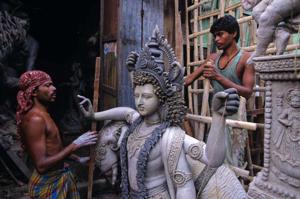
Every single clay Durga idol in Kolkata — whether she ends up in a modest para pandal or a crore-budget theme installation — begins her life in the narrow lanes of Kumartuli. When Nabakrishna Deb needed skilled idol-makers for his 1757 puja, he brought potters from Krishnanagar in Nadia district to settle on the banks of the Hooghly, chosen specifically because the riverbank clay was ideal for sculpting and easy to haul in. That settlement of "kumors" (potters) is exactly how Kumartuli got its name, and the Pal families who work there today are often the direct descendants of those original artisans. Walk through in the weeks before Puja and you'll see straw-and-bamboo armatures being layered with river clay, then painted eyes given their final, almost theatrical touch — the ritual moment called Chokkhu Daan, or "the donation of sight," believed to bring the goddess to life. No other single location in Kolkata makes the scale of the festival — thousands of idols, one riverside neighborhood — more visible.
4. Bagbazar Sarbojanin — The Puja That Belonged to Everyone (1919)
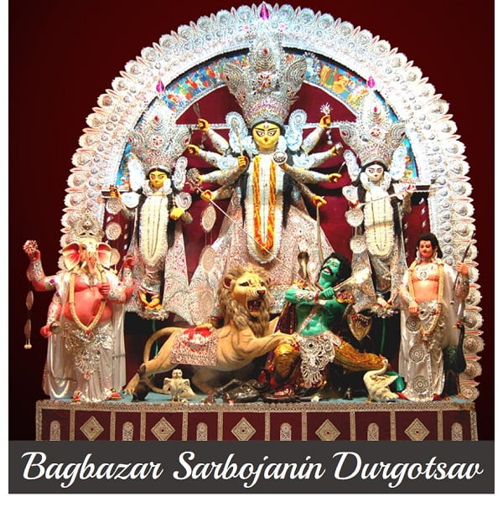
For over 160 years after Sovabazar Rajbari, Durga Puja in Calcutta remained a rich family's affair — ordinary residents were often shut out, especially when English patrons were the guests of honor. That changed in 1919, when residents of Bagbazar in North Kolkata could no longer watch the Sarkar family's private household puja continue due to financial strain, and instead pooled their own money to keep it alive as a community event at 55, Baghbazar Street. It was Kolkata's first-ever Sarbojanin ("for everyone") Durga Puja, initially called Lebubagan Baroyari Durga Puja, and it moved to its permanent home at the Bagbazar-Pashupati Bose Lane junction by 1928. Within a decade, this "people's puja" became a magnet for the freedom movement: Netaji Subhas Chandra Bose himself is remembered for championing mass participation here, and the pandal doubled as a venue for selling Swadeshi, "Made in India" goods during the independence struggle. Every barowari and sarbojanin community puja you visit anywhere in India today — the entire democratic model of Durga Puja — traces its lineage back to this one street corner.
5. College Square — Kolkata's Reflection on Water (1948)
The youngest entry on this list is still nearly 80 years old, and remains one of the most photographed pujas in the city for a simple architectural reason: the pandal is built directly beside the historic College Square pool, in the heart of the university quarter that also houses Presidency College and the University of Calcutta. Established in 1948, just after India's independence, College Square Durga Puja was among the first major pujas built by and for the city's academic and student community rather than a zamindar family or a mercantile neighborhood. Visit at night and the entire illuminated pandal doubles in the water of the pool — an image so iconic it has become shorthand for Kolkata Puja photography itself. Standing here, you're seeing the moment the festival's next era began: no longer aristocratic, no longer just working-class either, but civic, intellectual, and unmistakably of the city's college-going, adda-loving soul.
Reading the City Through Five Stops
Walk this list in order and you're not just pandal-hopping — you're tracing 270 years of who got to claim Durga Puja as their own: a courtier currying favor with the British in 1757, the craftsmen who gave the goddess her face for three centuries, the ordinary residents who wrested the festival from the aristocracy in 1919, and finally, a university neighborhood that made it civic in 1948. Each stop is minutes from a Metro station in North Kolkata, and each rewards a slow visit over a rushed one — go early in the evening before the crowds peak, and ask a family member or a Kumartuli artisan a single question about their history. In this city, someone is always ready to tell the story.